

Last update:
Manage user access
Aug 21, 2026
The Access tile in the Aikyam Identity Console enables AIC administrators and business advocates to manage customer identities (access governance) at scale across the portal. It provides two primary functions for managing user access:
- Post-authentication control: Defines post-authentication permissions for users within the target portal.
- Self-service access management: Allows business advocates, such as application owners and group owners, to manage roles, permissions, and groups within their assigned scope. This ensures users have the right level of access to perform their tasks securely across the portal.
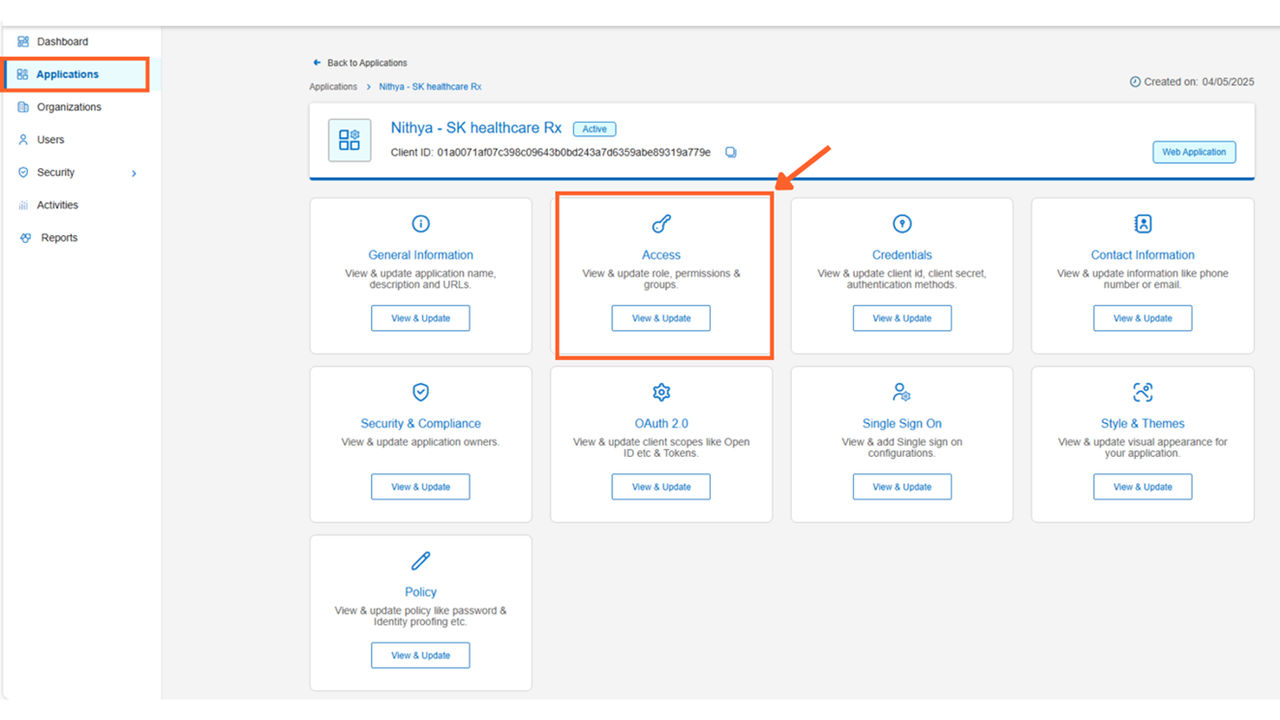
Access refers to different types of grants (permissions) that are available to authorized users on managed healthcare data and resources within applications. Access management enables you to model application roles and permissions based on the business roles and organizational divisions (Groups) and assign them accurately to the end users. This structure helps organizations avoid “access explosion” by ensuring permissions remain granular and business-specific.
Note: Advocates can grant application access to end users through the admin console. Access provisioning via B2B APIs is also supported.
Business advocates (Application and Group owners) dynamically determine who should have access to what resources, protecting against breaches and ensuring compliance with HIPAA and other regulatory frameworks.
These application permissions may include, but are not limited to:
- Read/View: Viewing data without making changes.
- Write/Generate: Adding or modifying data.
- Delete: Removing data.
- Execute: Performing specific actions or operations on the data.
- Track: Monitoring or keeping a record of data.
- Export: Transferring data to another format or system.
Implementing access governance in Aikyam Identity Console
Different roles have varying levels of interaction with applications, necessitating fine-grained access control. For instance, Just-In-Time (JIT) provisioning allows visiting specialists to gain limited access to resources in real-time.
For applications with complex roles and permissions, we recommend governance at the group or organizational level. Group auto-inheritance policy simplifies administration of users and ensures better control over access and permissions.
The image below shows an access explosion due to poor governance (left) and optimized user management through group-based access control using Aikyam Identity Console (right).
Previous:
Manage event hooks
Share additional feedback to help us improve.
0/255
|
Powered by Aikyam @2025 All rights reserved

+1 866 451 2735
 +1 866 451 2735

+1 855 819 5909