

Last update:
Authorization lifecycle
Aug 21, 2026
The authorization lifecycle ensures appropriate access throughout the user lifecycle and adapts as responsibilities evolve.
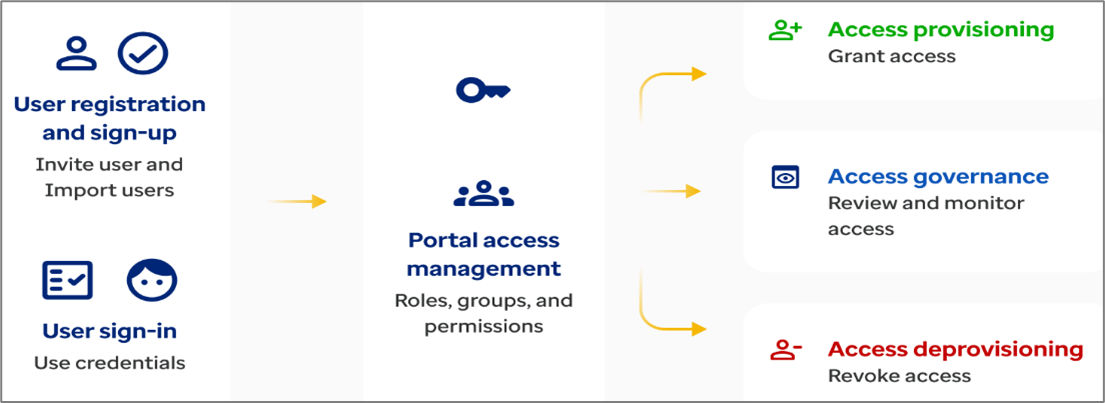
- User registration The lifecycle begins when a user is invited or registered within the tenancy (such as OHID, HSID). Users may be registered with baseline access or receive access later based on business needs and policy controls.Just‑in‑time (JIT) accessFor streamlined onboarding, the platform supports JIT access, allowing newly registered users to automatically receive predefined access without manual provisioning.
- Portal access management Portal access management establishes the authorization framework for the system, defining how access is modeled and controlled. This includes:
- RolesRoles define what a user is permitted to do based on their functional responsibilities.
- PermissionsPermissions specify the actions a user can perform, such as viewing, updating, approving, or administering.
- GroupsGroups represent business units or functional segments that bundle roles and permissions into well-structured access profiles.
Authorization modelGroup → Roles → PermissionsThis hierarchy supports scalable, maintainable, and least‑privileged access assignment. - Roles
- Access provisioningAfter groups, roles, and permissions are modeled, authorized administrators can assign the appropriate access to users.Authorized personas for provisioning:
- Application ownersManage access at the application level and oversee assignment of groups and roles.
- Group ownersManage access limited to their assigned business areas.
Assigning a user to a group automatically grants the associated roles and permissions, ensuring fast and consistent provisioning. - Application owners
- Access deprovisioning When a user's responsibilities change or access is no longer required, deprovisioning revokes access to prevent unnecessary privileges from accumulating. This strengthens security and reduces risk.
- Access governanceGovernance ensures that access remains accurate and compliant. It includes:
- Reviewing access regularly
- Reporting on user access and entitlements
- Validating permissions and group memberships
- Monitoring for policy violations or unusual access behavior
Why this matters
A well‑structured authorization framework ensures users receive the right level of access at the right time. It protects sensitive information, supports operational efficiency, reduces risk, and ensures compliance across the enterprise.test
Note: User access management and access governance capabilities are currently available only for OHID tenant-based applications. Support for additional identity providers will be added as they become available.
Previous:
Access control models
Share additional feedback to help us improve.
0/255
|
Powered by Aikyam @2025 All rights reserved

+1 866 451 2735
 +1 866 451 2735

+1 855 819 5909